
Vuelo & Aeropuerto

After collecting your luggage, follow the other passengers to the arrival hall. You will see our tour guide waiting outside with a sign displaying your name.

Si no logra localizar al guía, por favor llame a nuestro número de emergencia y permanezca donde está. Nuestro guía irá a buscarle.

For international flights, our tour guide will wait up to 2 hours, and for domestic flights up to 1.5 hours after the flight arrival. This is usually sufficient time for guests to reach the exit and meet the tour guide.

If you experience any issues inside the airport, such as lost luggage, please contact us immediately via our emergency number so the tour guide and driver can extend their waiting time. Without prior notice, they will assume a no-show and leave the airport.

Yes. Airlines in China follow the IATA global timetable system, which changes twice a year:

  • Summer schedule: from the last Sunday in March to the last Saturday in October.
  • Winter schedule: from the last Sunday in October to the last Saturday in March of the following year.

During these transitions, airlines may adjust flight times, flight numbers, and even routes. In some cases, flights may also be cancelled.

Economy Class:
Carry-on baggage: 1 piece per person, 7 kg per piece.
Checked baggage: The total weight per person cannot exceed 20 kg, each piece cannot exceed 40 × 60 × 100 cm in size.
Business Class:
Carry-on baggage: 2 pieces per person, 7 kg per piece.
Checked baggage: The total weight per person cannot exceed 30 kg, each piece cannot exceed 40 × 60 × 100 cm in size.

  • Additional baggage allowance can be purchased online in advance (cheaper) or at the airport (more expensive).
  • The exact online price for additional baggage allowance is available only after the air ticket has been issued.

No, excess baggage charges at airports in China are not typically negotiated. 

However, some airport staff may be lenient with overseas travelers and allow an extra 3–5 kg without charge. This is not guaranteed and depends entirely on the staff’s discretion and your luck.

In China, only power banks with a visible and valid China Compulsory Certification (3C) mark are allowed on domestic flights. This new rule, implemented on June 28, 2025, aims to enhance flight safety by preventing uncertified and potentially hazardous power banks from being carried on board. Power banks without this certification, or those with unclear or recalled models, will be confiscated at security checkpoints. 

We strongly recommend you not to bring your power bank purchased abroad to China when travelling to China.

Certification Requirements (China domestic flights)
Must display a clear 3C certification mark
Recalled, damaged, or unlabeled power banks are prohibited

✔ Capacity Limits
≤100Wh (≈27,000mAh): Allowed, no approval needed
100–160Wh (≈27,000–43,000mAh): Allowed with prior airline approval
160Wh (≈43,000mAh): Strictly prohibited

Wh Calculation: mAh × 3.7 ÷ 1000 (e.g., 20,000mAh = 74Wh; 10,000mAh = 37Wh)

✔ Quantity Limits
Maximum of 2 power banks per passenger
Some airlines may apply stricter rules

✔ Packing Rules
Carry-on only, never in checked baggage
Terminals must be protected (e.g., original packaging or tape)

✔ Smart Baggage with Removable Batteries
Battery must be easily removable without tools
Non-removable batteries not accepted in cabin
Removed batteries follow standard power bank rules (≤100Wh / approval for 100–160Wh)

In-Flight Restrictions
Must remain switched off
Cannot be used to charge devices
Cannot be recharged via aircraft power

❌ Banned Power Banks
Without 3C mark (for Chinese domestic flights)
Damaged or swollen batteries
Recalled models
Power banks with unclear capacity labels

1. Liquids in Cabin

International flights:
You may carry liquids, gels, and aerosols in your hand luggage if each container is ≤ 100ml, packed in a transparent resealable bag (total ≤1L).
China domestic flights:
All liquids are banned in cabin (except small cosmetics/toiletries ≤100ml, one per type, subject to inspection).
Beverages, water bottles, soups, etc. are strictly not allowed through security.

2. Alcoholic Beverages

International flights:
Duty-free alcohol can be carried in cabin (sealed, with receipt).
China domestic flights:
All alcohol must be checked in; no alcohol is allowed in hand luggage.

3. Duty-Free Purchases

International flights:
Duty-free perfumes, cosmetics, alcohol, and tobacco are allowed if sealed in security bags with receipts.
China domestic flights:
No duty-free system exists; such liquids must follow the strict domestic liquid rules (often confiscated if not checked).

4. Lighters & Matches

International flights:
Some countries/airlines allow 1 small lighter or safety matches on person (not in cabin bag, not in checked luggage).
China domestic flights:
Completely banned — no lighters or matches, either in carry-on or checked baggage.

5. Baby Milk / Liquid Food

International flights:
Baby milk, formula, and liquid food for infants are usually allowed in cabin (with baby present), subject to inspection.
China domestic flights:
Technically restricted under the “no liquids” rule; in practice, can only be brought in very limited quantities after inspection, and often more strictly enforced than on international flights.

❌ In Cabin (Carry-on)

  • All knives are strictly forbidden in hand luggage, no matter the size or type.
  • Even small souvenir knives, Swiss Army knives, or decorative daggers are not allowed through security.

✅ In Checked Baggage

  • Ordinary knives (e.g., kitchen knives, fruit knives, craft knives, souvenir knives) → Allowed in checked baggage.
  • Controlled knives (e.g., daggers, double-edged knives, spring knives, military/police knives) → ❌ Prohibited completely, cannot be checked or carried.

⚠️ Important:

  • Airport security sometimes asks to see knives in checked bags; they will reject any that fall into the “controlled knife” category.
  • China has strict laws on controlled knives — if a purchased knife looks like a weapon (combat knife, military dagger, butterfly knife), it may be confiscated at the airport, even if checked.

Train & Railway Station

In China, many railway stations have more than one exit (usually two). Guests may leave from any of them, but our tour guide can only wait at the exit closest to the assigned carriage. If you do not see the guide at the exit you take, please call the guide directly or contact our emergency number, and remain where you are. Our tour guide will come to find you.
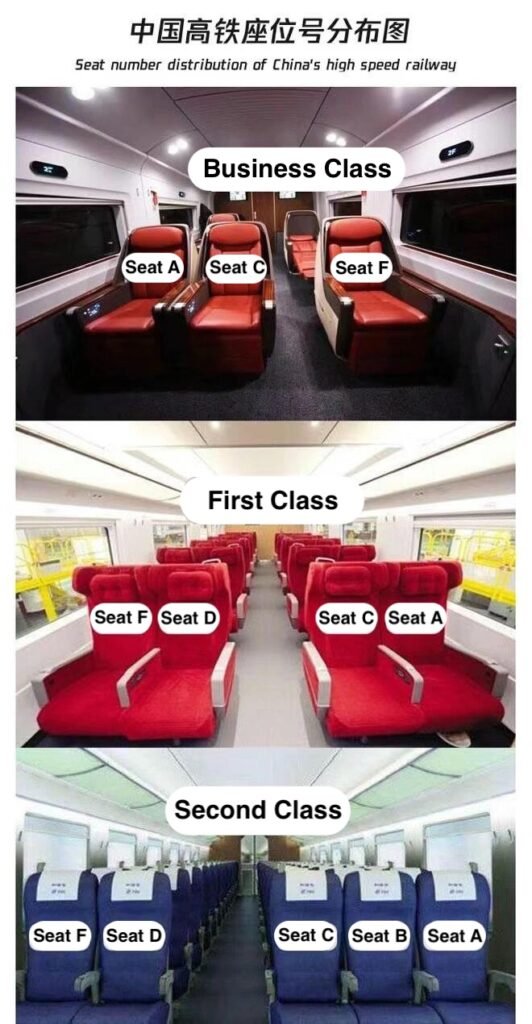
  • Business Class Seat – Luxury option; 3 seats per row (2+1 layout), wide reclining seats, sometimes lie-flat.
  • First Class Seat– More spacious; 4 seats per row (2+2 layout).
  • Second Class Seat – Most common and economical option; 5 seats per row (2+3 layout).

Train tickets in China can be purchased up to 15 days before departure (including the travel date) or 14 days before departure (not including the travel date).

  • On high-speed trains (G/D/C trains), we can only select the preferred seat type and seat location (e.g., window, aisle, or middle seat) when booking.
  • If the chosen seat type (e.g., window or aisle) is already sold out, the train system will automatically allocate the closest available seat according to the preference.
  • If multiple passengers traveling together, the system will also try to keep seats together. If that’s not possible, seats may be scattered in different rows or even different carriages.

*** Local Chinese travelers with ID cards can purchase tickets much faster than overseas travelers using passports, as this is how the railway system is designed—something beyond our control. For this reason, some of the fastest trains with convenient schedules may sell out within just a few minutes after sales open.

  • Only about 20% of trains are the fastest or have fewer stops, making them highly sought after by all travelers and therefore more difficult to obtain.
  • In addition, local Chinese travelers with ID cards can purchase tickets much more quickly than overseas travelers using passports, as this is how the railway system is designed—something beyond our control.s how the railway system was designed, we are not able to change.
  • After boarding, you can ask the conductor if there are better seats available and request a change.
  • Alternatively, passengers often swap seats voluntarily (especially to help families or groups sit together).

No! China Railway and Hong Kong cross-boundary trains have fully implemented electronic tickets, and paper tickets are not required for both adult and child tickets.

If the ID document used for ticket booking is a passport, Mainland Travel Permit for Hong Kong and Macau Residents, Mainland Travel Permit for Taiwan Residents, Residence Permit for Hong Kong, Macau, and Taiwan Residents, or PRC Foreign Permanent Resident ID Card, please use the manually staffed channel to enter and exit the station. If the ID document used for ticket booking is a mainland Chinese ID card, you can directly swipe your ID card to enter and exit the station.

There is no limit on the weight or quantity of luggage allowed on trains in China, as long as it is within the standard luggage size. Oversized items that cannot pass through the security check machine will not be permitted.

  • Explosives, flammable and toxic substances (e.g., gasoline, kerosene, paint, thinner, firecrackers).
  • Weapons and items resembling weapons (guns, ammunition, controlled knives).
  • Corrosive chemicals (acids, alkalis).
  • Radioactive materials and other dangerous goods.
  • Illegal drugs, narcotics.
  • Live animals (except guide dogs).
  • Alcohol (24–70% vol.): max. 3000 ml, sealed and labeled.
  • Perfume, floral water, sprays, gels (non-pressurized, flammable ingredients): ≤100 ml per container, 1 per type.
  • Nail polish, polish remover: ≤50 ml total.
  • Hair dye, hair spray, insecticide, air freshener (self-pressurized containers): ≤150 ml per container, 1 per type, total ≤600 ml.
  • Matches: ≤2 small boxes.
  • Lighters: ≤2 ordinary lighters.
  • Power banks & spare lithium batteries: capacity ≤100Wh; must be clearly labeled; not allowed in checked baggage.

Availability

  • Many large and busy stations (e.g., Beijing South, Shanghai Hongqiao, Guangzhou South, Xi’an North) provide porter service.
  • It is less common at smaller or regional stations.

How It Works

  • Licensed porters usually wear red caps or vests (so sometimes it’s called “Red Cap Service” 红帽子服务).
  • They help passengers carry luggage from the station entrance or waiting hall to the train carriage, and sometimes directly to your seat.

Cost

  • Typically 10–30 RMB per piece of luggage, depending on the station and distance.
  • Payment is made directly to the porter (cash or mobile payment like Alipay/WeChat).

Limitations

  • Service is first-come, first-served and not always guaranteed during peak times.
  • Advance booking is usually not available.
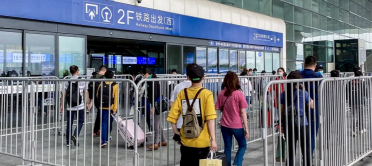
Step 1: Enter the station

Show the valid ID used when booking the ticket to station staff to enter the station. Valid ID types include mainland Chinese ID card, passport, Residence Permit for Hong Kong, Macau, and Taiwan Residents. If required, you may need to show the relevant booking information.
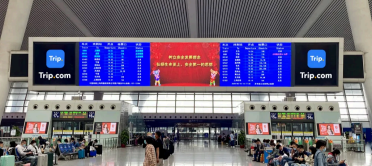
Step 2: Check the electronic screen

Find your platform on the electronic screens at the station.
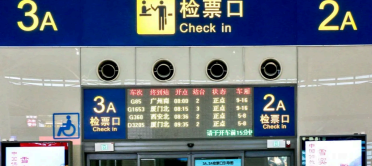
Step 3: Find the boarding gate

Find the boarding gate for your train on the electronic screen in the station. Head to the area near your gate and wait for boarding to begin.
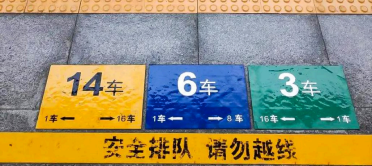
Step 4: Go through boarding gates

Show the valid ID used at the time of booking to the attendant. ID types include passports, Mainland China ID cards, Residence Permits for Hong Kong, Macau, and Taiwan Residents, etc.

Pass through the gate and find the correct platform for your train.

On the platform, we recommend asking the attendant the correct boarding location for your carriage.
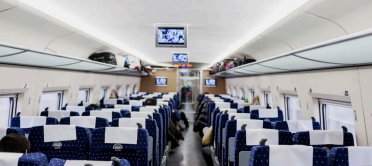
Step 5: Boarding

Find the carriage and seat number according to the ticket information.

Our tour guide will escort guests to the boarding gate. From there, you will only need to enter the gate with your passport, locate the correct carriage, and find your seats.
***Please note that our tour guide is not permitted to enter the boarding gate with guests


Ground Service

It is essential that any complaint, inconvenience, or dissatisfaction related to the trip be communicated at the moment it occurs. In this way, we can review it and take the necessary measures to resolve the situation immediately. Complaints or disagreements that are not reported during the course of the trip and are instead presented once the trip has ended will be much more difficult to address, and therefore we will not be able to consider or handle the situation in the same way.

We appreciate your understanding and cooperation. Our 24-hour emergency contact numbers are:

  • +86 186 1113 8169
  • +86 159 0121 3893

Normally, all our services include the assistance of a foreign language–speaking tour guide, along with a driver and vehicle.

In the rare case that a tour guide is not included, we will inform the agents in advance and clearly indicate this in our confirmation.

No. About 99% of drivers in China speak only Chinese. In fact, if a driver speaks good English, he or she would usually work as a tour guide rather than as a driver.

No. Driver-guide service is not fully legal in China and may pose safety concerns. As we provide luxury travel services for high-end travelers, we ensure that all our services are fully compliant with regulations and meet the highest standards of safety and quality.

Yes! We strongly recommend avoiding the following three periods when planning your trip to China:

  • Tourist attractions are extremely overcrowded, making it difficult for guests to enjoy their visits.
  • Entrance tickets for popular sites, such as the Forbidden City and the Terracotta Warriors Museum, cannot be guaranteed.
  • Most tour guides refuse to work during these times.

1. Chinese New Year / Spring Festival

  • When: Late January or February (dates vary each year, based on the lunar calendar).
  • Why avoid: It’s the biggest annual holiday in China. Hundreds of millions of people travel to their hometowns, making it the largest human migration in the world.
  • Impact: Trains and flights sell out weeks in advance, prices skyrocket, many businesses close, and tourist sites are packed.
  • Tip: If you want the cultural experience, it’s fascinating — but logistics are very tough for travelers.

2. Labor Day

  • When: May 1–5
  • Why avoid: Many Chinese take short domestic trips; attractions, hotels, and transport are packed.
  • Impact: Tourist sites like Beijing’s Forbidden City, the Great Wall, and Shanghai’s Bund are extremely crowded.

3. National Day Golden Week

  • When: October 1–7 every year.
  • Why avoid: Celebrates the founding of the PRC. It’s one of the two busiest travel weeks of the year.
  • Impact: Trains, flights, and hotels are fully booked; tourist sites are overcrowded; prices surge.
  • If guests have not specified a location, the meeting point will always be the hotel lobby.
  • At the end of each service day, our tour guide will inform or confirm the pick-up time for the following day.
  • For full-day tours, the recommended hotel pick-up/start time is 9:00 AM.
  • For international flights (including flights to Hong Kong or Macao), the recommended pick-up time is 4 hours prior to departure.
  • For domestic flights, the recommended pick-up time is 3 hours prior to departure.
  • For domestic train journeys, the recommended pick-up time is 2 hours prior to departure.

We will do our best to arrange the same guide for the guests’ entire stay in each city. However, during peak season, especially in July and August, it may be necessary to assign more than one guide to serve the same group.

  • Tips may be given to the tour guide and driver at the guest’s discretion.
  • Both the guide and driver will be happy to receive the tips from the guests.
  • For groups of fewer than 10 persons: 100 RMB (approximately 14 USD) per day for the guide, and 50 RMB (approximately 7 USD) per day for the driver.
  • For groups of more than 10 persons: 20 RMB (approximately 3 USD) per guest per day for the guide, and 10 RMB (approximately 1.5 USD) per guest per day for the driver.

Please refer to the following webpage:

  • All the vehicles we have quoted are fully licensed for tourism and include the required insurance.
  • We can provide a supplement for luxury cars, such as Mercedes-Benz, which are generally used for business travelers. However, please note that these types of vehicles typically do not carry a tourism license.
  • In some cities, luxury cars without a tourism license may need to park farther away than licensed vehicles.
  • in some cities, such as Beijing, due to local regulations, luxury cars without a tourism license are restricted from circulation one day out of every five (Monday to Friday). On such days, we would need to arrange an alternative vehicle of a similar type.
  • If the guests are comfortable with these possible inconveniences, we will be glad to provide you with a supplement quotation for luxury vehicles.

To avoid last‑minute changes, we typically share the tour guides’ contact details 7 days before the guests’ arrival.

  1. Book a tour with us: Independent travel in Tibet is not permitted. Guests must book their trip through an authorized Chinese travel agency (such as ours).
  2. Apply for a Chinese Visa (except visa-free travelers): We will provide a dummy service confirmation or an itinerary without mentioning Tibet. Guests can use this document to apply for a Chinese visa.
  3. Send the below documents to us
    • A clear copy of the passport’s first page
    • A copy of the valid Chinese visa (except visa-free travelers)
  4. Application submission: We will submit the application to the Tibet Tourism Bureau (TTB) in Lhasa 30–40 days before the guest’s arrival in Tibet.
  5. Processing time: The approval process usually takes 8–15 working days.
  6. Permit Issuance: The Tibet Tourism Bureau (TTB) will send the approved permit to us in the city from which guests will depart for Tibet.
  7. Permit Delivery: Our local tour guide will hand the original Tibet Travel Permit directly to the guests.

Important Notes:

  • The permit is checked when boarding flights or trains to Tibet, so guests must have the original document (scanned copy is not accepted).
  • The permit only covers the Lhasa region and basic areas. If traveling to restricted areas (e.g., Mt. Kailash, Mt. Everest Base Camp, Nyingchi, Chamdo, etc.), guests will also need additional permits (Alien’s Travel Permit, Military Permit), which we can arrange once guests are in Tibet.
  • Guests cannot apply for the permit on their own; it can only be obtained through a local travel agency on behalf of international travelers.
  1. By Ferry (Traditional & Classic Way)
    • Operators: TurboJET, Cotai Water Jet
    Departure Points in HK:
    • Hong Kong Macau Ferry Terminal (Sheung Wan, HK Island)
    • China Ferry Terminal (Tsim Sha Tsui, Kowloon)
    • Hong Kong International Airport (Skypier – for transit passengers)
    Arrival Points in Macao:
    • Outer Harbour Ferry Terminal (near city center)
    • Taipa Ferry Terminal (near Cotai / casino area)
    Duration: ~55 minutes – 1 hour
    Frequency: Every 15–30 minutes during the day
  1. By Bus via Hong Kong–Zhuhai–Macao Bridge (HZMB)
    • Route: Cross the 55 km sea bridge linking HK, Zhuhai, and Macao
    • Duration: ~40–60 minutes (excluding border checks)
    • Cost: About HKD 65–150 per person
    • How: Shuttle bus (“Golden Bus”) runs 24 hours between HK Port ↔ Macao Port
  1. By Helicopter (Fastest & Luxury Option)
    • Operator: Sky Shuttle Helicopters
    • Route: From Hong Kong (Sheung Wan Heliport) → Macao (Outer Harbour Heliport)
    • Duration: ~15 minutes
    • Frequency: Every 30 minutes (daytime)
  1. By Private Car (with Cross-Border Permit)
    • Requires a special dual-plate license and advance approval.
    • Normally used by VIP travelers, companies, or pre-arranged limousine services.
    • Uses the Hong Kong–Zhuhai–Macao Bridge route.

✅ Summary:
• Cheapest & most popular: Ferry
• Most flexible & 24h: Bridge shuttle bus
• Fastest & luxury: Helicopter
• Exclusive: Private cross-border car

Yangshuo is a district of Guilin, about 80 km away. It feels more like a small village, but it has luxury resorts such as Banyan Tree.

Guilin is the main city, with more restaurants and nightlife, though it doesn’t have true luxury hotels — the best options there are Sheraton and Shangri-La.

Most of the key attractions are in Yangshuo. The famous show Impression of Liu Sanjie is also in Yangshuo.

If guests prefer to stay in Yangshuo, please note the costs are higher: hotels are more expensive, and we also need to cover the guide’s and driver’s accommodation and meals.

Our suggestion:

  • If they prefer a luxury hotel, Yangshuo is the better choice.
  • If they are happy with hotels like Sheraton and would enjoy local restaurants and nightlife, Guilin is more suitable.

normalmente no incluimos los almuerzos para grupos de menos de 10 personas, pq antes de la pandemia, muchas veces incluíamos comida china, clientes dijeron que no les gustó comida china, si incluíamos comida occidental, se quejaron que estaban en China porque no les damos comida china.  Ahora los guías recomiendan restaurante según su interés. 

Una cosa importante, duración de los servicios del dia de 8 horas que cotizamos, está incluido una hora para que pueden almorzar.

Consejo de viaje

Yes! We strongly recommend avoiding the following three periods when planning your trip to China:

  • Tourist attractions are extremely overcrowded, making it difficult for guests to enjoy their visits.
  • Entrance tickets for popular sites, such as the Forbidden City and the Terracotta Warriors Museum, cannot be guaranteed.
  • Most tour guides refuse to work during these times.

1. Chinese New Year / Spring Festival

  • When: Late January or February (dates vary each year, based on the lunar calendar).
  • Why avoid: It’s the biggest annual holiday in China. Hundreds of millions of people travel to their hometowns, making it the largest human migration in the world.
  • Impact: Trains and flights sell out weeks in advance, prices skyrocket, many businesses close, and tourist sites are packed.
  • Tip: If you want the cultural experience, it’s fascinating — but logistics are very tough for travelers.

2. Labor Day

  • When: May 1–5
  • Why avoid: Many Chinese take short domestic trips; attractions, hotels, and transport are packed.
  • Impact: Tourist sites like Beijing’s Forbidden City, the Great Wall, and Shanghai’s Bund are extremely crowded.

3. National Day Golden Week

  • When: October 1–7 every year.
  • Why avoid: Celebrates the founding of the PRC. It’s one of the two busiest travel weeks of the year.
  • Impact: Trains, flights, and hotels are fully booked; tourist sites are overcrowded; prices surge.